

John Brookfield | 144 pages | 2012
It is perhaps not surprising that I am a fan of history and history podcasts. In particular I like Dan Carlin‘s Hardcore History and his focus on the “extremes of the human experience”.
In one episode, Carlin covers the 1536 Münster Rebellion. In his intro, Dan comments that a house guest inspecting his library would not be surprised by a volume on medieval torture, but might be surprised to find three volumes on medieval torture…
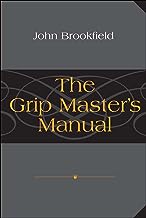
I was reminded of this when I downloaded The Grip Master’s Manual, which is the sequel to Brookfield’s Mastery of Hand Strength.
Having already acknowledge that grip strength is a niche topic, I can well imagine a guest’s surprise at my unusual reading list – even if it is a little less macabre than Carlin’s.
This volume continues Brookfield’s exploration of novel grip and forearm strengthening exercises. The format and tone is slightly different to the first book. He starts with a chapter on old-world manual labor, especially blacksmiths, lumberjacks and fishermen, highlighting the constant physicality of the jobs and emphasizing the need for functional strength vs. regular lifting.
I attended a medieval re-enactment market shortly after reading the book and spent some time watching the blacksmith. Obviously this guy was playing a role, but the constant hammering, gripping tongs and moving metal bar around certainly validated Brookfield’s point. Desk bound at a computer, it does not matter how much gym time I carve out, it will not compete.
He goes on to discuss hand health, briefly looking at hydration, circulation, massage and cardio work, before getting into the meat of the book – another series of unique exercises using low-cost, home-made equipment.
Brookfield looks at deadlifting irregular real-world objects like boulders – such as primitive farmers clearing fields, or gathering stone for buildings. He considers the irregular objects harder to lift and superior exercises, while highlighting the inherent risk of lifting with a bent back vs. the ideal, straight-backed form a barbell permits.
He also looks in depth at lifting a stack of objects (e.g. house bricks) by squeezing them at the sides to hold the stack together, and tossing weights from hand to hand.
There is a big focus on specifically training each muscle of the hand and forearm with exercises for each finger, including extension and dexterity work under load – for example rolling up a golf towel tied to a suspended bucket of sand in one hand.
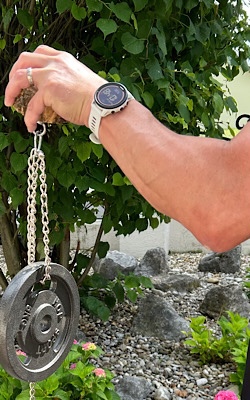
I have not tried all the exercises – there are just too many of them – but I was inspired to cut a chunk off a thick branch as a handle with a chain fitted to it so I can adjust the load.
With dumbbells, I would normally curl 15-19KG depending on the number of reps I am targeting. With this claw grip contraption, I had to start with only 5KG, although I was able to increase quickly after a few sessions. I feel this curl at the top of the forearm, just below the elbow, so it is hitting different muscles to an ordinary curl.
Overall, The Grip Master’s Manual is a quick and easy read that does exactly what is says on the tin. It could have been edited down a bit, but the conversational style is consistent with a couple of guys in a shed experimenting with wood, concrete and duct tape. There are a lot of interesting ideas in there and I think it is worth taking two or three of the exercises to test.
One challenge I see with the exercises is that they are not clearly measurable in the way a barbell bench press is. This could undermine motivation if you don’t see/feel improvements but it is always worth exploring new ideas.

Talking of new ideas, the Münster Rebellion was part of the reformation that swept through Europe after Martin Luther got his hands on a Gutenberg Press.
If you are interested, Dan Carlin gives a great account of the whole affair, up to and including a pretty graphic description of the brutal punishment inflicted on the rebel leaders.
Their broken bodies were suspended in cages from the spire of the city’s main church. When he said that the cages were still hanging there, nearly 500 years later, I had to go and see it for myself – it’s true!
These guys really know how to hold a grudge.
 Caveman Musings
Leave a comment