

I am writing this after a couple of days hiking in the Bayerischer Wald National Park. Just me and the dog with minimal human interaction, exploring forest and mountains. It seems I am learning something as there was no sunburn, dehydration or blood-letting the entire time. This will become relevant later.

The Bayerisher Wald hugs the border between the German state of Bavaria and the Czech Republic. It is no longer truly wild, but it as close to Little Red Riding Hood forest as I have seen, complete with saplings pushing through the leaf litter, dappled shadows over mountain streams, berry-laden brambles, spider webs across the rocky trails, and abundant poisonous redcap toadstools. There are no wolves any more, but apparently there are some wild lynx roaming about and I did hear a large bird that, to my untrained ear, was definitely a hungry eagle.

The rocky peaks (especially Lusen) are magnets for the day trippers, but you can achieve real isolation in the forests – my dog and I both heartily recommend it.
…but this tale begins much earlier…
October 2017 in South London was unusually hot and sunny, with nary a grey cloud or raindrop to be seen. The same could be said for my cave girls who were back in Germany for a long weekend. I was alone on a Sunday with time to kill and no plans in mind.
Option 1: Go check out the new Blade Runner movie at the London IMAX
Option 2: See if I could force march my way from Richmond to the Thames Barrier…
It was only a three minute walk to the Thames, just by Ham House. Once there, I just had to turn right and follow the river all the way to the Barrier. No advanced navigation required. Just keep marching. And marching. And…. marching.
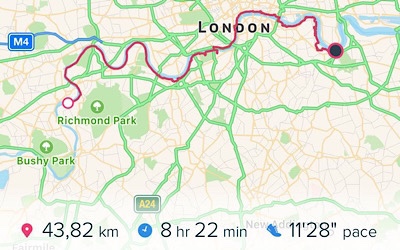
At least that was the plan. According to the official Thames Path site, Ham House to the Thames Barrier is 28 miles or 45KM. That is a long hike but the terrain is flat so should be doable.
As this was a completely spontaneous action, I had made no preparations. After a leisurely breakfast, I threw a liter of water, two protein bars and an apple in a backpack and headed out. What could possibly go wrong? Fair weather, easy route through a city. No emergency blankets, rations or candles required…
Of course it was hotter and sunnier than I anticipated. Construction at Battersea pushed me to cross over to the North bank which gave close up view of the main city sites.
I should have stopped for a rest and bought more water, but I was a man on a mission and solely focused on my goal. I also tend to forget the consequence of direct sun on male pattern baldness.
At the Tower of London, I switched back to the South bank into the gentrified urban rabbit warren that wraps around the docklands. Here I was forced to detour from the river for some stretches and my progress deteriorated rapidly.
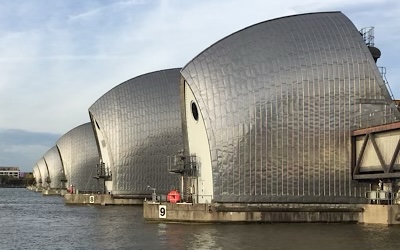
In the end, I made it as far as the Cutty Sark, some 5K from the Thames Barrier. I had finally registered the sunburn and recognised that I was hungry, dehydrated and a bit broken. Public transport from the Barrier is a messy combination of buses and trains, while there was a convenient station right by the Cutty Sark; I stopped, got some cold water inside me and called it a day. Disappointed not to have seen the Barrier, but I knew I had given it a good effort for an unplanned venture.
It was in the cool, dark tube station that everything went bad. Seven minute wait for a train, I leaned back against a signpost and got the overwhelming urge to close my eyes for a moment. I now know that is a bad idea, but it happens so rarely, that you cannot really prepare for it. Next thing I knew I was waking up on the platform floor with a crowd of concerned citizens clustered around me. I had passed out and whacked my head on a stone as I went down. Bloody gash and black eye forming, making for a very unpleasant trip home with other passengers unsure if I was an unhinged tramp or a drunken thug but carefully avoiding me either way.
Back at work the following week, no-one could quite believe that I had voluntarily marched to the point of collapse. Although in truth it was stubborn refusal to rest and failure to take account of the heat and dehydration that did me in.
A couple of weeks later I was attending a corporate dinner hosting some visiting dignitaries. By this time, the bruising and stiffness had all gone. I was suited, booted and looking presentable as we all sat to eat. That inevitable moment when you realize you know more or less nothing about the bigwig sitting next to you, and wondering what they are interested in talking about. Some wisecracking colleague decided the story of me collapsing on the tube would be an excellent ice breaker.
Thank you Steven. I have have not forgotten.
To turn it around, I explained to the foreign executive that I like to set tough targets, and that one cannot push to the limit without sometimes exceeding the limit – as had happened on that sunny Sunday.
Because if you never test to failure, you never really know what your limits are.
Now I am not a masochist, and I aspire to live a long and healthy life, but I actually do believe it is useful to know your own limits and to sometimes experience hunger, thirst and exhaustion. We evolved to thrive with periodic deprivation, and you never really know what you can achieve or how hard you can push unless you sometimes test yourself to the limit – and that means testing to failure.
The trick is to do it without causing any long term damage.
With exercises like deadlift and overhead press this is easy – drop the bar. For bench press, I avoid putting collars on the bar. If I get stuck, I can tip one side of the bar causing the plates to (very loudly) drop off one side – normally causing a see-saw effect for a second loud bang of plates coming off the other side. Embarrassing in a busy gym perhaps, but really not a big deal.
I have never actually failed a squat from the bottom position. If I really don’t think I am going to make it, I abandon the rep right at the start. This probably means I could squat more than I think I can – my brain is firing off failsafes before my body gets into trouble.
Mild deprivation – hunger, thirst, heat, cold, etc. (no free seat on the train), is easy to experience and easy to dismiss as irritating or irrelevant. I am not inclined to test deprivation to extremes intentionally, but it is worth reflecting on past experiences and trying to build an appreciation for what your real limits are.
I believe that the simple practice of testing limits and understanding how deprivation affects you (yes, I get hangry), gives you a better appreciation of what your body is capable of, and, over time develops the mental toughness to push harder and grow stronger. You also learn how to mitigate controllable limits; in my example, drinking water and wearing a hat avoided any problems in the Bayerisher Wald despite the 32C heatwave we were enjoying at the time.
Come the Zombie Apocalypse, mental toughness, and ability to handle deprivation will be distinguishing survival traits. Again, my dog and I both heartily recommend it.
 Caveman Musings
Leave a comment