


Continuing my series on injury, prevention and recovery, this time I am looking at shoulders. I find that shoulder and elbows take the most damage from my particular style of Power Lifting. I have learned to be slow and deliberate in my movements and focus on learning and maintaining good form in all the key movements, but stuff happens…
A little bit of googling will throw up endless articles on shoulder issues, highlighting that the shoulder is a complex joint with a lot of small rotator cuff muscles that are easily injured. Additionally lifters are prone excess inward rotation because we tend to focus on mirror muscles so the chest is worked more aggressively than the back, creating tight pecs that pull the shoulders forward. Additionally, if you read about overhead press, you will come across lots of discussion about the narrow gap in the shoulder bones that nerves pass though and are therefore prone to impingement. Finally, a lot of people have lousy posture (no really, it’s true!)
So there is a lot going on and plenty of opportunity to hurt yourself.
When I first started lifting, I was very careful about performing dumbbell or cable shoulder rotations as part of my warm up routine. It never really felt very effective and did not do anything to avoid pain from behind-the-neck-press or upright row – both of which are likely to promote impingements. In hindsight and with a little more knowledge, I think both of these exercises are pointless and dangerous. I avoid the pain by just not doing them. There are better ways to build your delts and traps.
In Convict Conditioning, Paul “Coach” Wade argues that even the traditional barbell overhead press with the bar starting at the clavicle is too deep and a potential trigger for impingement issues, advocating instead for handstand pushups where you cannot go so deep because your head is in the way. While there are plenty of old school strong men such as John Grimek that proved the efficacy of handstand pushups, they are really, really hard to perform! I did learn to handstand against a wall, but never managed more than a fractional push up. Overhead press with 2.5KG progressive increments is just easier to build up.
Athletes who never do anything but bench press tend to have more shoulder problems than those who include overhead training.
Mark Rippetoe Starting Strength 3rd Ed
I spent several years working on overhead press with the goal of pressing 80KG (176lbs) with a body weight of around 100KG (220lbs). I found that I could rapidly progress to 60KG but then around 65KG I would hurt my shoulder or arm (typically somewhere on the deltoid) and have to back off, recover and start over.
This cycle repeated several times until I started to think about balance, adding more rowing movements and chin-ups to build up my back strength to support my shoulder girdle. I also added isolation work for my triceps (but neglected my biceps which I think was a mistake with respect to balanced strength). It took me about four years to achieve a 75KG (165lbs) overhead press at which point I moved on to other things. The key was slow progression and maintaining more-or-less balanced strength across my upper body.
At some point in this journey, I learned about the gymnastic movement, Shoulder Dislocates, in which you rotate a dowel over your head and back. This is a great movement. You can pick up a dowel very cheaply, and add small plates to it as you get stronger. When travelling, you can even perform the movement with a rolled up towel.
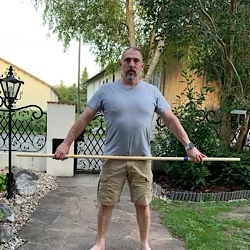
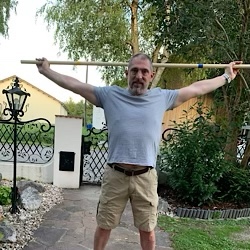
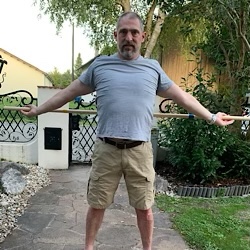
When I do Shoulder Dislocates, I aim for one set of 20 reps, holding the rod in the back position for a few seconds 5x per week, adding a 1.25KG (2.75lb) plate each week. When I do this for four or more weeks conscientiously, I feel my upper back get stronger and my posture taller. It definitely works! For me this is vastly superior to dumbbell rotations.

If you look at the contraction on your back at the end position, it is clear that everything is getting tight. The hold at the end position may simply be a stretch for the arms or an isometric strength movement for the shoulder girdle. I don’t know, but you feel mild soreness on the first set and a few weeks later you will realize that you are walking tall with shoulders back. I recommend it.
Back in 2019, when I was competing in the Wolf Run, I wanted to complete every obstacle, including the monkey bars. This was a mistake! I am too heavy relative to my strength, to safely swing single-handed from bar to bar. Maybe if I lose 10KG I might try it again, but suffice to say I hurt my shoulder good and proper, to the point that I could no longer even squat with a normal barbell and had to switch to a safety bar which has two handles welded onto it. It took a good six months of recovery until I could squat with a normal bar, and even then I switched to an eagle claw grip.

Interestingly, while I was working on my recovery, I came across Shoulder Pain? The Solution & Prevention by John M. Kirsch M.D. It reads like a presentation that has been put into book form with minimal editing. The main idea is that you can heal shoulder pain by spending time in a two-handed dead hang on a regular basis.
Hanging is also advocated by old time lifters for back health and grip strength, so I have no issue with this approach. The key I think, is to use both hands in a dead hang rather than swinging about. I did experiment with the protocol but I cannot say whether it, or six months healing was the solution.
I would have been happy to end the story there, but as I ramp up my training ahead of the 2023 German Drug Free Powerlifting competition, I tweaked my trapezius and took the precaution of visiting a sport physiotherapist. He immediately identified that there was a blockage (probably a poor translation from German) under my left shoulder blade, which dated back to the 2019 injury and was the root cause for the trapezius twinge. He spent 25 minutes manipulating my shoulder. It was not particularly painful, but it was effective.
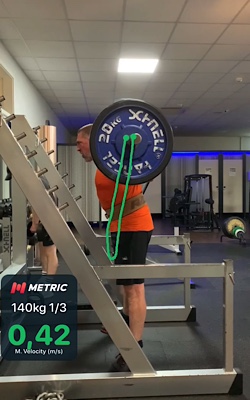
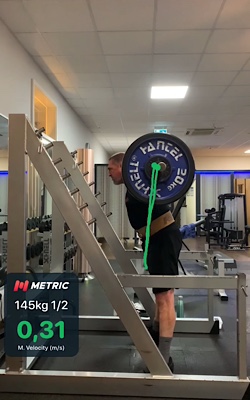
The incredible thing for me was the immediate impact on my squat. I try to train “low-bar” back squat which should facilitate a consistent and vertical bar path shown in the green lines in these before and after pictures.
The week before the physio session, I have the bar a couple of centimeters higher on my back, resulting in a forward dipping U-shaped movement. A couple of days after the session, I had the bar slightly lower, giving a straighter and more consistent movement which should translate to a higher 1RM. I felt the bar physically lower against the backs of my arms which is what triggered me to compare the videos.
Lesson learned: if you do get injured, go see a good physiotherapist. I could have done that years ago…
In summary, my guidelines for shoulder health are:
- Avoid pointless exercises that are prone to impingement (upright row, behind-the-neck-press)
- Try Shoulder Dislocates for external rotation and posture
- Try to balance chest and back work
- Try hanging with both hands from a bar for multiple 30s sets, but avoid swinging or single handed hanging unless you have the strength to handle your body weight
- If you have an old injury get some physiotherapy to work on any knots, adhesions, or blockages
If you have additional ideas to promote shoulder health, I would love to hear about them below.
I video my barbell lifts with the awesome app Metric VBT, which uses an algorithm to track the movement of the bar giving you insight into velocity and consistency of your lifts and tracking bar paths. If you are wondering about the title for this piece, it comes from the 1981 classic Excalibur, after the final battle when Lancelot dies in King Arthur’s arms.

 Caveman Musings
Leave a comment