

Mark Sisson | 457 pages | 2009
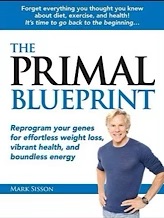
As a middle-aged Englishman, I am not prone to excessive hyperbole. It is true that I have lived overseas most of my adult life, and have lost the extreme reticence of an Edwardian butler, but it will be a cold day in Hell before I describe something as “Awesome!”
That said, The Primal Blueprint is one of two books I read over Christmas 2011 that changed the trajectory of my life. (The other was The 4-Hour Body which I will review separately.)
At the time, I had been single for 18 months, dieting for over a year with mixed success and trying to overcome severe hypertension. My initial approach was somewhat naïve and simplistic, based on “common knowledge / common sense” without any special measuring or analysis:
- Abstain from the obvious bad foods (alcohol, cookies, chocolate, dessert)
- Swap out a cooked lunchtime meal for salad plus fruit and bread roll
- Exercise some degree of portion control on the evening meal
- Add a mid morning protein bar because I knew that was a better option than a bigger breakfast
At the time, I knew nothing about nutrition and very little about cooking. At a bloated maximum of 130KG, I had fairly easily and consistently gotten down to 110KG over a six month period, then more or less flatlined despite increasing exercise and starting to drink protein shakes. Over the second six month period, I managed to grind down to the 107-105 range but was not making any real progress.
So it was that I decided to use the holiday period to get educated and refine my thinking.
The Primal Blueprint is really a lifestyle book masquerading as a diet book – or maybe it is a holistic diet book that considers all the topics beyond food to achieve a healthy body weight and composition.
Sisson’s foundation principle is that pre-agricultural hunter-gatherers were fitter, stronger and had larger brains than early farmers. Further, humans evolved for millennia as hunter-gatherers and have only adapted to a farming in the last 10,000 years, so we are genetically predisposed to the hunter-gatherer lifestyle. If we can adopt elements of that lifestyle (maybe without the sabre tooth tigers) our genes will express the strongest and fittest self we can be.
In Guns, Germs and Steel, Geography Professor and Anthropologist Jared Diamond supports the foundation statement, but offers a different explanation…
“Archaeologists have demonstrated that the first farmers in many areas were smaller and less well nourished, suffered from more serious diseases, and died on the average at a younger age than the hunter-gatherers they replaced.“
“Once people began to produce food and become sedentary, they could shorten the birth spacing and produce still more people, requiring still more food. This bidirectional link between food production and population density explains the paradox that food production, while increasing the quantity of edible calories per acre, left the food producers less well nourished than the hunter-gatherers whom they succeeded. That paradox developed because human population densities rose slightly more steeply than did the availability of food.”
Occam’s razor aside, even compelling and simple explanations cannot always be taken at face value. Not that it really matters in this case, because the only relevant question here is whether or not the Primal Blueprint works…
After a storytelling us-and-them comparison chapter, Sisson goes on to present a series of lifestyle rules that can reasonably allow modern Westerners to emulate our forebearers. He augments his proposals with lots of research studies, data and personal anecdotes to support his position.
It is worth noting that this book was first published in 2009, before sitting was the new smoking, before resistant starch and brown fat were a thing, and back when the gut microbiome was a fringe topic not mentioned in polite circles. Most of Sisson’s proposals have meanwhile become fairly well accepted in the mainstream, but he presents a logical and defendable foundation that is far more plausible than some wannabe influencer yelling at me through my phone.
The core element of his approach to diet is to control blood sugar by restricting carb intake to 100-150g/day range. He specifically eliminates sugar and wheat (gluten), but is pretty much against all grains, beans, pasta and potatoes. He supports a moderate to high intake of “quality proteins” and rounding out the daily caloric needs with healthy fats (monounsaturated and saturated fats, not polyunsaturated) – with a special look at Omega 3 / Omega 6 ratios. The goal is to transition from carbs as the primary energy source, and become a “fat burning beast”.
For accelerated weight-loss, he advocates eating 50g or less of carbs per day to achieve ketosis, or experimenting with intermittent fasting (this all predates the Keto Diets are are now common). I did try getting down to 50g for a couple of weeks; it was not easy, and I never achieved ketosis which you can measure by peeing on a paper strip. Again, food databases and tracking tools were pretty poor at this time, so it is entirely possible that I was consuming more carbs than I thought, but I don’t know where they were hiding.
My biggest concern on first reading was his attitude to fiber which he considers largely unnecessary – he revised that position a bit a few years later when Resistant Starch hit the scene for supporting healthy gut microbiome, but I almost disregarded the entire approach because I wanted fiber in my diet, as recommended to me by a doctor when I was a teenager. My go-to solution had been a switch from cornflakes to branflakes and I had not really understood that there was plenty of fiber available in vegetables. When I decided to start following the Primal Blueprint eating plan, I was cautious about fiber consumption but in practice, following the plan I never had any issues.
In the six months that I followed the blueprint strictly, my weight dropped from the previously flatlined 105KG to 90KG. Somewhere in the fifth or sixth month, I had a professional body fat analysis performed which clocked me at 14% fat and my doctor took me off hypertension meds; it works!
It took some work to learn the principles, define menus and stick to the plan – especially when visiting friends or family. I also more-or-less abandoned eating out. I had to learn a lot about food sourcing and preparation. It is easy to get sucked into considering micronutrients in way too much detail which is counter to the simple concept – although I still want to know if adding balsamic vinegar to a salad really reduces the glycemic impact of the meal…
The Primal Blueprint includes a strong emphasis on exercise and play. Sisson advocates for playing outdoors in the sun, climbing trees and balancing etc. He approves of weight training, lots of walking and occasional sprinting but is strongly opposed to what he terms “Chronic Cardio”, although as a former Marathon and Iron Man competitor, his definition of “chronic” is probably a bit higher than most of his readers.
I was already lifting and walking a lot in this period and had just started running. I completed my first half marathon and kicked off a new romance during this same six month period – important to understand as this almost certainly contributed to the weight loss and body composition; I cannot solely attribute the change to the diet.
In Summer 2012, a holiday visiting family in Southern Italy inevitably reintroduced pasta and wine to my eating plan. I was able to keep my weight in the 95-97KG range for a couple of years but as I got more relaxed with the rules, the weight slowly came back. I still follow the basic principles and I am healthier and stronger than I was 15 years ago but carrying more fat.
In conclusion, The Primal Blueprint presents a holistic lifestyle approach to healthy diet and exercise that helped me lose a lot of weight and overcome hypertension. More than a decade later, and only complying maybe 70% with the principles, I am still healthier, fitter and leaner than I was in my 30s.
Sisson’s writing style is jovial but a little verbose. He comes from the “tell them what you’re gonna tell them, tell them, then tell them what you told them” school. He credits his editor with cutting the wordcount significantly, but I think they could easily trim another 20% without impacting the value of the content. Some gems such as the Grok Squat and Hang are well buried in the verbiage but this is book worth reading multiple times.
The subtitle “…effortless weight loss, vibrant health and boundless energy” is of course marketing nonsense. Weight loss ultimately requires discipline and caloric restriction for an extended period. That is never effortless. You must be willing to invest time and energy learning a new way of thinking about food and probably a lot more time cooking. Energy is never boundless, although I am for sure healthier and more resilient on this eating model.
 Caveman Musings
Leave a comment