

Initial Challenge; Update 1 (three weeks); Update 2 (seven weeks); Final Update (fifteen weeks)
There are some lessons I need to relearn periodically; accidents happen when you are in a rush and taking short cuts, take lots of water when hiking on a hot day!
Today, the lesson I am relearning – tendon pain takes a really, really long time to fix (think months, not days).
Over the years, I’ve periodically trashed my elbows, knees and wrists. Currently I am dealing with some problems in my right ankle which has been severe enough to warrant focused attention.
Normally I can pinpoint the act of stupidity that broke me, but I actually have no idea why my right ankle is playing up. I was on a trip to Tunesia in March, running around a big hotel looking for my room, when my ankle went audibly pop and I was limping. The tendon was (and still is) visibly swollen and sensitive to pressure.
I don’t know if sudden movement after hours sitting on planes and buses was the trigger, but I think the underlying root cause is lack of mobility in my calves and hamstrings – not a new challenge but one I need to take seriously now.
I did not do anything special for the following six weeks. Morning stiffness and a few minutes pain after getting out of bed diminished somewhat, but did not go away. I was able to run, but the following day, the pain would always be more intense.
So over the last two weeks, I have been proactive – and successful enough to try a faster paced run. Big mistake. Back to pain and limping for a couple of days. Remember! Tendon pain takes a really, really long time to fix. So focus on avoiding rather than curing it…
But when the damage is done, what are my options?
The laundry list for this intervention includes:
- Clean Eating to minimize systemic inflamation
- Vitamin E, Ginger and Turmeric as anti-inflammatory agents
- Kicking off a general mobility routine (8 minutes 5x per week) to address underlying inflexibility
- Achilles Running Socks and only running at a slow (7:15 or slower) pace
- Using a slant-board at my stand up desk for 1-3 10 minute sessions on weekdays
- Wearing a splint in bed to keep the Achilles stretched
Two weeks of this protocol worked well enough that I was confident to try a run at a 6:30 pace. That was a mistake and threw me back several days. I will stick with the super slow running for the foreseeable future!
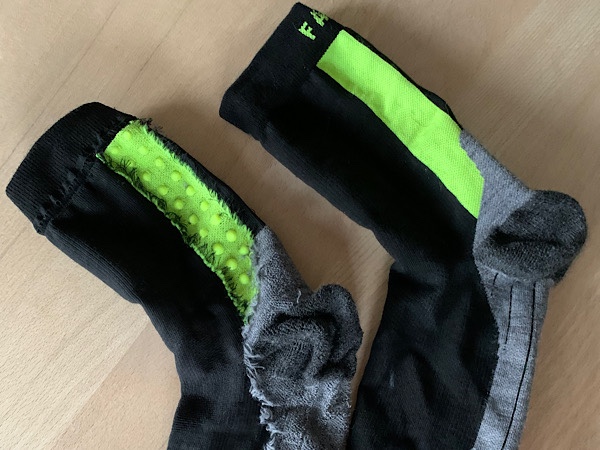
I had never heard of Achilles Running Socks but found them on Amazon. They are not cheap – essentially a compression sock with rows of plastic bumps that run down both sides of the Achilles Tendon. When I run 5K or less at a sub 7:15 pace while wearing them, I do not get any new pain. Faster, longer or normal socks all leave me limping again. I don’t think they are actively curing the problem, but allow me to train in a limited fashion without making it worse; I’ll take that!
The slant board has three settings; 20, 30 and 40° angle. So far I am only using the 20° option. The idea is to stretch out the calf to prevent further injury. In Anatomy for Runners, Jay Dicharry advocates holding a static stretch for at least three minutes to affect muscle tissue – I can manage 10 minutes on the slant board before it becomes uncomfortable. But it works well under my stand up desk…
Except when the Achilles is aggravated by excessive running, the biggest problem is in the morning on waking, when the ankle is stiff and painful to walk on. I think sleeping with feet relaxed shortens the calf or Achilles for several hours, triggering the morning pain. Hence a split to keep the foot flexed all night and keep the calf/Achilles stretched…
My first attempt with a split was a plastic monstrosity that looked like it would be used to secure a broken ankle; may I never actually break my ankle! It wrapped around the calf and under the foot at a fixed 90° angle with a detachable foam insert for an additional 20° elevation. Very uncomfortable and impossible to go to the bathroom without waking the household. It lasted one night only.
Next, I switched to a black velcro number that wraps around the foot and ankle with a curved steel rod held over the top of the foot. It is all adjustable and does not need to be super tight to hold the foot at around 80°. The effect is immediate. No morning pain.
In conclusion, two weeks into the protocol, these interventions are working. I can still lift and run without aggravating the Achilles so long as I am sensible. But as I already knew, tendon pain takes a really, really long time to fix.
Read on progress after three weeks of this protocol here

 Caveman Musings
Leave a reply to Oops I did it again (update 1) – Caveman Musings Cancel reply