
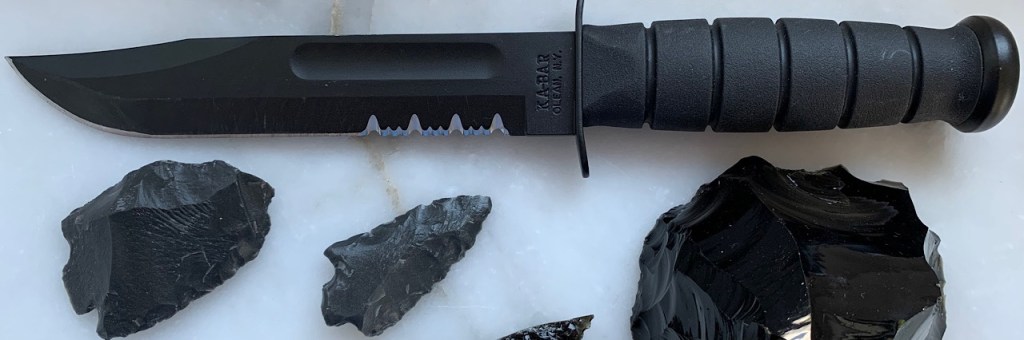
When I signed up for my first primitive skills class on fire lighting, the instructor sent out a requirements list which included a knife.
Knowing nothing about knives, I asked an ex-military co-worker for advice, and he immediately referred me to the MC KA-BAR. I told him I needed it for fire making and he assured me it was the perfect knife for every situation…
So I found myself wandering the aisles of a sporting goods store on Route 22, NJ, looking for the recommended tool.
For those not familiar with the Garden State, Route 22 spans the state East-West, predating I78. It is lined with an endless array of stores and billboards, and is especially known for both the quantity and the quality of its used car dealerships.
The sporting goods store in question sold guns so had barred windows and an armed guard at the entrance. And everyone in the place totally ignored me as I wandered past walls of weapons.
To be fair, I was a soft, podgy software engineer in a scruffy short-sleeved dress shirt, looking like an extra from Apollo 13 who had forgotten his pocket protector that morning.
The indifference changed in a heartbeat when I finally asked where I could find the MC KA-BAR. A hushed anticipation fell over the store as the salesperson beckoned me over to an alcove, unlocked a draw and pulled out a velvet-lines tray bearing three unsheathed knives.
Taking the middle blade in both hands and proffering it like a crown, he presented the knife.
“This”, he said with reverence, “is the Marine Corps KA-BAR, made from 1095 carbon steel alloy to hold an edge and for easy sharpening, plus a serrated saw edge for jungle work”
“You see this groove on the side? That is so when you stick someone, there will be no suction resisting the withdrawal.”
I nodded in appreciation, not wanting to to explain I just needed to make a few pointy sticks, and became the proud owner of a very big knife.
The fire lighting class was a blast and I recommend it without reservation, although the KA-BAR was a bit overkill for the task.
My second class on flint knapping involved a bunch of guys sitting around a fire pit for a long weekend breaking and shaping flint and obsidian while listening to the instructor’s stories and getting too much sun.
I learned that heart surgeons use obsidian edged blades to this day as nothing is sharper, but they are brittle and do not make great reusable arrow heads. Instead, early hunters would carry a lump of rock known as a blade core with which to bang out new blades as needed – although I spent three days establishing that this is a hard-won skill.
So super sharp single use Obsidian made on demand, or an MC KA-BAR that will outlive me so long as I keep it sharp and rust free.
Come the Zombie Apocalypse, the KA-BAR, is probably the way to go, but I will still need to maintain it. How will I oil and sharpen it when there is no such thing as a hardware store?
For fire lighting we are taught to lubricate the non-pointy end of the stick with grease from the side of your nose – an option I guess. Alternatively, in his autobiography, “The Conquest Of New Spain”, conquistador Bernal Díaz del Castillo describes rendering fat from the bodies of fallen comrades as a medicinal salve…in the end, where there’s a will, there’s a way!
But a little planning always helps. When you can’t run out to the hardware store and you are dependent upon your own wits and whatever resources you have stashed or can find, you will succeed or fail based on your skills and mindset.
Bottom Line: knife sharpening is a critical skill – one to learn before you absolutely need it.


 Caveman Musings
Leave a reply to But Grandma! What sharp teeth you have! | Caveman Musings Cancel reply